The Briefing You Never Got
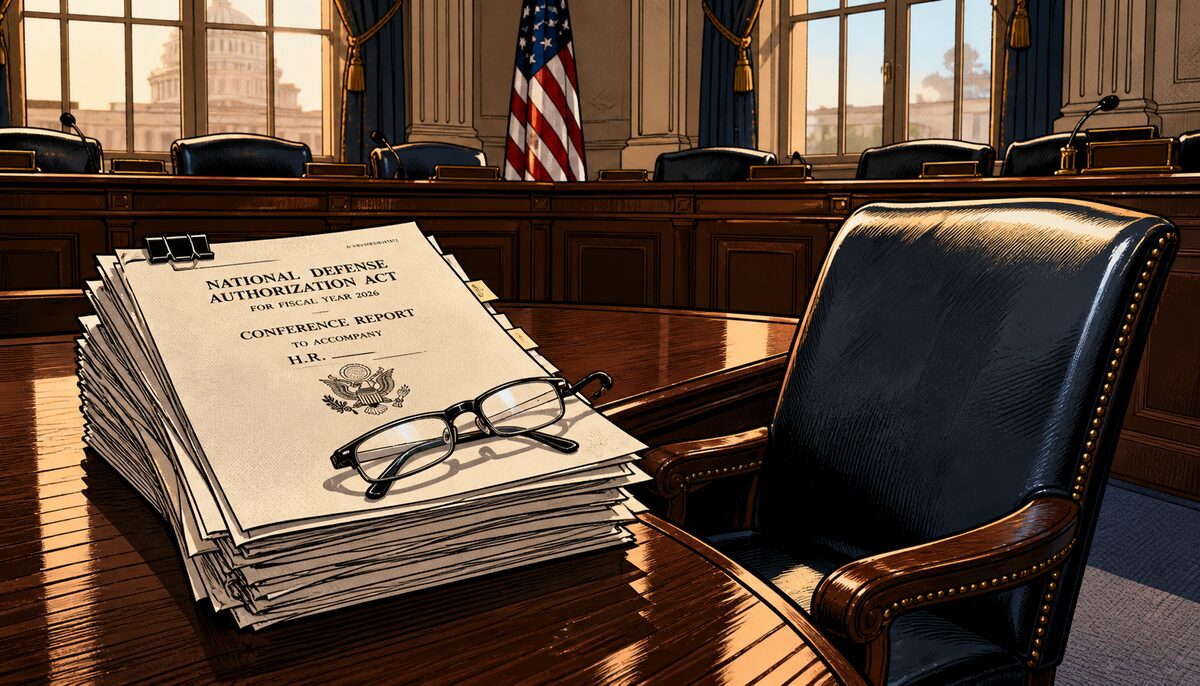
Every December, Congress passes a defense bill that touches more American lives than any other piece of legislation. And every December, almost nobody reads it. The FY2026 National Defense Authorization Act — signed into law on December 18, 2025 as Public Law 119-60 — runs longer than the last three Harry Potter books combined. The version Congress voted on includes an executive summary, a joint explanatory statement, and a conference report. The summary alone is 80 pages. The Senate vote was 77-20. The House was 312-112. And then the news cycle moved on.
If you live near a military base, work at a hospital, run a small business, or pay taxes, that bill changed your life this month. You just weren’t in the briefing.
I spent twenty-five years in uniform reading documents like this — the Air Force version, the joint version, the inside-the-fence version. The thing nobody tells you on the way out: the briefing is never written for you. It’s written for the audit, the appropriator, and the prime contractor’s lawyer. So this week I’m going to translate.
What $900 Billion Actually Buys
The headline number is $900.6 billion authorized for the Department of Defense, plus $34.3 billion for Department of Energy national security work and another $512 million in defense-related activities scattered across other agencies. That’s a record. That’s $8 billion more than the President’s own request. Both parties added to it.
Where does it go? The answer matters because the answer is mostly people, hardware, and bets.
- Pay raises for service members. If you have a son or daughter in uniform, their paycheck went up.
- Shipbuilding, aircraft, vehicles, munitions. Manufactured in 49 of 50 states. If you have a cousin working at a shipyard in Newport News, a tank plant in Lima, or a missile line in Tucson, the money landed there.
- $9.1 billion for cybersecurity core operations and $612 million for cyber research. Translation: when the bill says “cyber,” it’s the same kind of work that protects your bank’s wire transfers, your hospital’s patient records, and the local water utility’s control system. The Pentagon spends this money first; everyone else benefits second.
- Bets on the next war: hypersonics, autonomous systems, AI, mobile micronuclear reactors, high-energy lasers. These are line items that show up as press releases now and as factories in the Midwest in five years.
The “Peace Through Strength” framing in the press release is political language. The actual numbers are deeply bipartisan and have been for two decades. That’s the part the briefing leaves out.
The Quiet Cuts Civilians Felt
Here’s what the celebratory press releases didn’t lead with. The final bill removed a provision restoring collective bargaining rights for hundreds of thousands of Department of Defense civilian employees — those rights had been stripped earlier in the year by executive order. AFGE National President Everett Kelley put it bluntly: “Congress should not be in the business of weakening national security by weakening the workforce that makes national security possible.”
If you have a relative who’s a civilian engineer at a depot, an analyst at an installation, or a logistics planner in a defense agency, their bargaining power just changed. That isn’t classified. It’s right there in the bill. It just wasn’t in the briefing.
A second cut: TRICARE will only cover IVF and other fertility services for service members whose infertility was caused by a serious illness or injury sustained while on active duty. A broader provision passed both the House and Senate versions. It was negotiated out in conference. If you’re a military family that was counting on it, the policy you tracked all year went away in the last forty-eight hours of legislating.
Defense policy isn’t written for the briefing room. It’s written for the audit, the appropriator, and the prime contractor’s lawyer. The civilian reader is rarely in the room — and the things they care about are rarely in the final cut.
Why Congressional Intent Gets Diluted
Lee Drutman’s The Business of America Is Lobbying (2015) made the case years ago that the gap between what Congress says and what it does isn’t accidental — it’s structural. Bills are drafted by staff. Staff are influenced by experts. Experts are funded, in part, by the same industries the legislation regulates. By the time a clean idea (universal IVF, restored bargaining rights, fully funded military spouse employment programs) reaches the conference committee, it’s been negotiated against three other clean ideas, and one of them gets cut for the sake of the deal.
This isn’t cynicism. It’s mechanics. Section 1108 of the FY26 NDAA quietly expands direct-hire authority for defense industrial base entities at installations — a small change with big downstream effects on which contractors can ramp staff fastest. Section 712 establishes a Military-Civilian Medical Surge Program of record, partnering DoD with the U.S. healthcare sector. Section 737 directs a study of mental-health impacts on military and civilian UAS operators and imagery analysts — a population almost no one in the public knows exists.
None of those provisions made the news. All of them will reshape someone’s career.
What Got Bigger, Quieter
The under-reported story is acquisition reform. The Streamlining Procurement for Effective Execution and Delivery (SPEED) Act — announced in mid-2025 by Chairman Mike Rogers and Ranking Member Adam Smith — became the spine of this NDAA. It restructures how the Pentagon buys things. If you run a small business that’s ever tried to sell to the government, you know that the process is the punishment. SPEED is the most serious attempt in twenty years to fix it.
The bill also nearly doubled down on China-focused R&D — hypersonics, AI, autonomous systems, lasers, micronuclear. The Pentagon estimates $20 billion in cost savings across the bill. That figure will be argued for years, but the direction of travel is clear: the U.S. defense industrial base is being rebuilt around competition with the PRC, and the dollars in this NDAA are the down payment.
What this means for you
- Read your local angle, not the headline. The base, the depot, the shipyard, the cyber range nearest your zip code is what this bill funds. The headline number is theater. The local impact is real.
- If you or a family member is a DoD civilian, your workplace just changed. The bargaining-rights cut is the most under-reported civilian-impact provision in the bill. Know where you stand.
- If you sell to the government, learn SPEED. Acquisition reform of this magnitude only happens once a generation. The small businesses that adapt fastest will eat the lunch of those still waiting on the old process.
Sources & Fact-Check Trail
- Primary policy text: FY26 NDAA Conference Text Legislative Summary (House Armed Services Committee). Senate Executive Summary. Cited via Holland & Knight FY26 NDAA Comprehensive Analysis.
- Civilian-impact reporting: House Passes FY26 Defense Spending Bill, $900.6B; Senate passes 2026 NDAA — what’s included (19th News, Dec 2025); 2026 Defense Spending Bill Boosts Cyber Budget, Removes Hiring Requirements (FedWeek).
- Framework cited: Lee Drutman, The Business of America Is Lobbying (Oxford University Press, 2015) — for the structural gap between Congressional intent and final law.
- Web-verified facts: $900.6B authorization, P.L. 119-60 enacted 18 December 2025, Senate vote 77-20, House vote 312-112, $9.1B cybersecurity core funding, $612M cyber R&D, removal of collective-bargaining provision, TRICARE IVF restriction, SPEED Act acquisition reform — all verified against committee documents above.
About the Author
Michael Komorous is the host of Voice for Valor, a podcast dedicated to sharing the stories of military veterans, first responders, and their families. A combat-rated Air Force officer, Mike served as a nuclear missile operator, C-17 pilot, and MQ-1 Predator pilot before managing rated personnel across the Air National Guard. His policy career spans legislative affairs, defense acquisitions, and geopolitical strategy at OSD Policy, including analysis of the war in Ukraine.
Today Mike builds AI systems and leads Alpha Zulu Solutions, a service-disabled veteran-owned small business focused on defense technology and government contracting. He studies advanced analytics and is a research professor at George Mason University.
Watch the podcast on YouTube | Visit voiceforvalor.com | Connect on Facebook