The worst time to build your decision system is after the phone rings.
Every veteran knows the feeling.
Not the crisis itself. The thirty seconds before it becomes official. The hallway goes quiet. The radio traffic changes. Somebody says your name in a tone that means the day just stopped belonging to you.
The civilian version is quieter, but it has the same shape. A customer calls with a problem. A teaming partner changes the deal. A contract opportunity opens with a deadline that laughs at your calendar. A family emergency lands in the middle of the week you were supposed to finally get ahead.
You do not rise to the occasion in that moment. You fall to the system you already built.
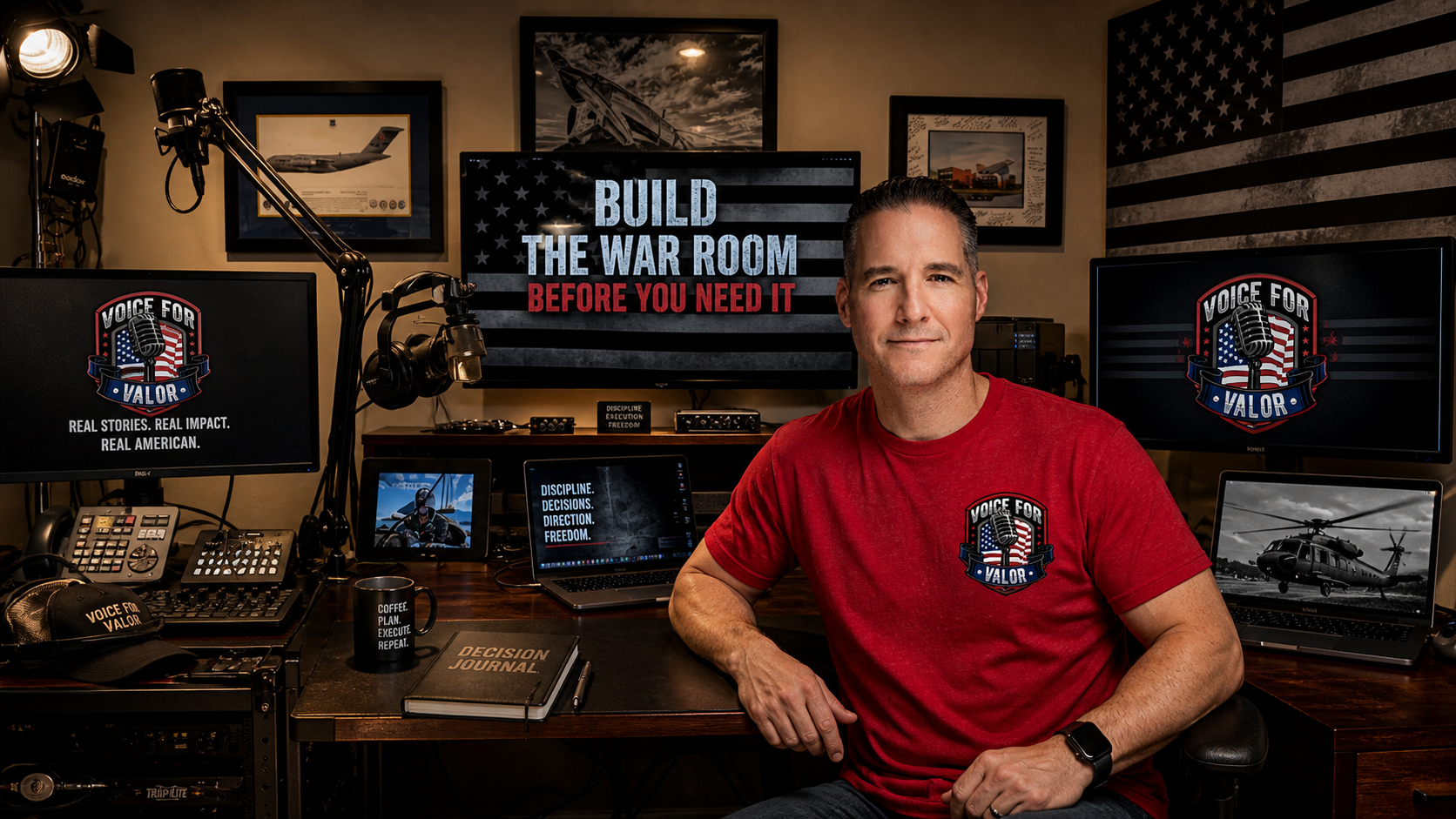
That is why every veteran founder needs a war room before they need one.
The War Room Is Not a Room
I do not mean a cinematic bunker with glass boards and glowing maps. Most of us are working from a kitchen table, a garage office, a spare bedroom, or the corner of a shop where the Wi-Fi is strong enough to reach the printer.
A war room is not furniture. It is a place where the facts stop wandering.
It is the notebook where you keep the decisions you made and why. It is the calendar where deadlines become visible before they become emergencies. It is the folder where the current version of your capability statement lives. It is the short list of people you call when the situation changes. It is the one page that tells you what matters this week.
The point is not to look organized. The point is to make confusion expensive enough that it has to leave the room.
A war room is where the facts stop wandering.
What Goes On the Wall
Start smaller than your pride wants you to start.
Put five things where you can see them.
First, the mission. One sentence. Not a slogan. The real answer to what you are building and who it helps.
Second, the next three decisions. Not your next twenty tasks. Decisions. Do you bid or pass? Do you hire or wait? Do you call the prime or fix the deck first? Tasks multiply. Decisions focus.
Third, the deadline board. Anything with a date goes there. Proposal deadlines, customer calls, bills, medical appointments, school events, board meetings, renewals. If it can ambush you, it belongs on the board.
Fourth, the people list. Customers, partners, mentors, accountant, attorney, banker, benefits office, the friend who tells you the truth without making a performance out of it. When the stress hits, you will not magically remember who to call. Write the names down before you need them.
Fifth, the decision journal. Date, situation, options, decision, reason, result. Nothing fancy. The journal is not there to shame you. It is there to catch the pattern before the pattern catches you.
Field Rule: If the same problem surprises you twice, it is no longer a surprise. It is a missing system.
The Veteran Advantage
Veterans already understand this. We just forget to bring it home.
In uniform, almost nobody trusts memory under stress. We use checklists, briefs, handoff notes, timelines, maps, crew coordination, after-action reviews. We write things down because the mission is bigger than anybody’s mood that morning.
Then we leave, start a business, and somehow decide the whole operation can live in our head.
It cannot.
Your head is for judgment. Your system is for storage. When you make your brain carry every deadline, promise, bill, risk, and idea, you are not being tough. You are spending attention on storage that should have been handled by paper, software, or a board on the wall.
The advantage is not that veterans are calmer under pressure. Some are. Some are not. The advantage is that we have already lived inside operating rhythms that work when the day gets ugly. Morning check. Situation update. Decision point. Debrief. Reset. Repeat.
That is a business system if you are willing to call it one.
Build It This Weekend
Do not buy anything expensive.
Clear one surface. Put up one board. Open one notebook or one digital document. Make four headings: Mission, Decisions, Deadlines, People. Then add a fifth page called Decision Log.
Give yourself forty-five minutes.
Write the mission in plain English. List the next three decisions. Put every deadline you know about in one place. Write the names of ten people you would call if the week went sideways. Then write today’s date in the decision log and answer one question:
What am I avoiding because it is unclear?
That answer is your first war-room task.
Do not make this sacred. Sacred systems get abandoned the first time life gets messy. Make it useful. Coffee stains are allowed. Bad handwriting is allowed. Cross-outs are allowed. A system you actually touch beats a perfect system you admire from a distance.
Your head is for judgment. Your system is for storage.
What This Means for You
If you are a veteran trying to build something after the uniform, stop waiting until the next hard week to find out whether your life has a command center.
Build the smallest one that works. One board. One notebook. One rhythm. Ten minutes in the morning, ten minutes at the end of the day, one honest review on Friday.
The war room will not make the hard things easy. It will make them visible. That is enough to change the outcome.
The phone will ring eventually.
Build the system before it does.
About the Author
Michael Komorous is the host of Voice for Valor, a podcast dedicated to sharing the stories of military veterans, first responders, and their families. A combat-rated Air Force officer, Mike served as a nuclear missile operator, C-17 pilot, and MQ-1 Predator pilot before managing rated personnel across the Air National Guard. His policy career spans legislative affairs, defense acquisitions, and geopolitical strategy at OSD Policy.
Today Mike builds across three connected ventures:
- Voice for Valor — veteran storytelling, leadership writing, and conversations with military veterans, first responders, and the families who support them.
- DoD Industry Advisor — defense-market intelligence, capture strategy, and advisory work for companies navigating the Department of Defense.
- Alpha Zulu Solutions — a service-disabled veteran-owned small business delivering defense technology, supply-chain support, and government-contracting solutions.
Watch the podcast on YouTube | Voice for Valor | DoD Industry Advisor | Alpha Zulu Solutions