
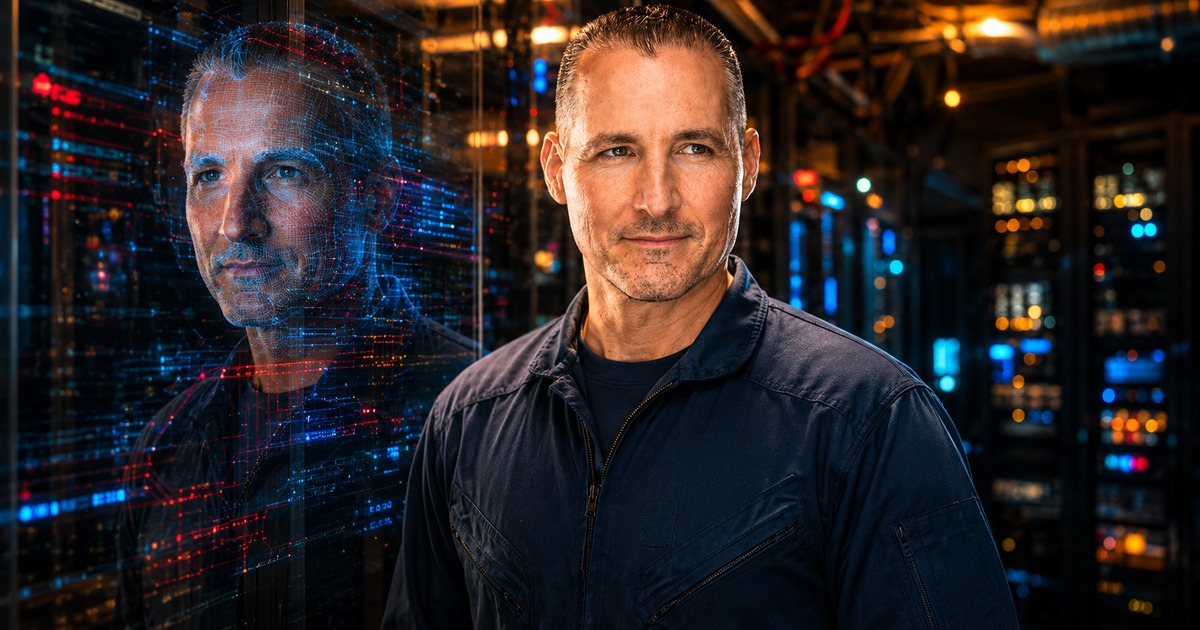
The Pentagon’s GenAI.mil platform just hit 1.7 million users. But the real shift is not another app. It is something deeper: the creation of a parallel reality that has been building for decades.
The Three Waves of Computing
Think about how computing moved through your life.
First came the mainframe era: big rooms where experts shared one giant computer. Then the personal computer arrived, and suddenly everyone had a machine on a desk. Now we are in the third wave: ubiquitous computing, where devices are embedded in everything — your watch, your car, your fridge, your home thermostat.
Each wave brought something new. The first gave us computation. The second gave us information interaction. The third brings what researchers call cyberization: the creation of digital entities that exist in parallel with the real world and can reshape it.
That is the shift behind the GenAI.mil news.
It is not just that the Pentagon now has a powerful AI platform. It is that we are stepping into a world where digital things have their own existence, their own behaviors, and their own ability to act on the physical world.
What Is a Cyber Entity?
A cyber entity is not just a file or a database entry. It is a digital thing that exists in cyberspace — whether it was created purely by a computer, or whether it is a digital mapping of something real.
Think of your Ring doorbell. The physical camera sits on your porch. But the live feed, the recorded clips, the motion alerts that go to your phone — those are cyber entities. They live in the digital world. They can be accessed anywhere. They can trigger actions. They exist beyond the single piece of hardware bolted to your house.
A 2015 paper published in IEEE Access, “Cybermatics: A Holistic Field for Systematic Study of Cyber-Enabled New Worlds,” lays this out systematically. The researchers identify the mainframe, personal computer, and ubiquitous computing eras, then argue that we are entering a phase where cyber entities proliferate and combine with real-world entities to form cyber-physical, cyber-social, and cyber-mental systems.
That sounds abstract until you realize you are already living inside it.
The Cyber World vs. The Real World
The paper makes a useful distinction between the cyber world and cyber-conjugated worlds.
The cyber world is the purely digital realm: cyberspace, servers, models, accounts, profiles, automated agents, and all the digital things inside them.
Cyber-conjugated worlds are where the digital and physical blend.
Your smart home is a simple example. The thermostat is physical. The cloud service is digital. Your schedule is digital. Your energy bill is tied to both. The system can sense, decide, and act back into the physical world by changing the temperature in your house.
That is not just data storage. That is a bridge between worlds.
Your Uber account works the same way. It maps to your real identity, real location, real payment method, and sometimes a real car. But it also has properties that do not exist in the physical world: ratings, trip history, preferences, pricing behavior, and algorithmic decisions that shape what happens next.
This is why cybersecurity feels different now.
You are not only protecting information. You are protecting the bridge between your physical life and the cyber entities that represent, influence, or act on it.
Why We Need a New Field
Computer science gave us computation. Information science gave us data processing. But neither field was designed for a world where digital entities can act on the physical world.
That world is already here.
A Fitbit can shape a health intervention. A smart grid can reroute power. A connected vehicle can receive a remote update. A social platform can affect real-world behavior. GenAI.mil can help analysts and staff officers make decisions that touch real operations.
The Cybermatics researchers argue that we need a broader field for this new environment — one that studies cyber entities, cyber worlds, and the way digital systems combine with physical, social, and mental life.
That is not just an academic naming exercise. It is a change in how we understand risk.
If your digital footprint is only data, then the problem is privacy.
If your digital footprint is a cyber entity with behaviors, permissions, dependencies, and links to the physical world, then the problem is control.
What This Means for You
Your digital footprint is not static.
That account, that profile, that AI assistant, that cloud-connected device, that digital twin — each one has properties and capabilities that may not map cleanly to your physical life.
So the practical move is simple: stop auditing your digital life like a filing cabinet. Audit it like an operating environment.
Ask three questions:
- What cyber entities map to my real life? Start with your identity accounts, financial accounts, phone, car, health apps, home devices, and work systems.
- What can those entities do without me watching? Look for permissions, automations, stored payment methods, location access, delegated agents, and connected services.
- What physical consequence follows if they are compromised? Think beyond embarrassment or data loss. Think access, money, movement, safety, reputation, and decision-making.
If you cannot answer those questions for your most important accounts and devices, you are not managing your digital twin.
It may already be managing you.
The Real Lesson
We are standing in a transition between conventional life and cyber-enabled life.
The military sees it. Researchers see it. Anyone building products, policy, or AI systems should see it too.
The next era is not simply “digital.” It is cyber-conjugated: digital entities connected to physical systems, social systems, and human judgment.
That makes Cybermatics more than a strange academic word.
It is a useful name for the world we have already entered.
Sources: Defense One reported GenAI.mil’s 1.7 million user milestone in July 2026. The Cybermatics framework comes from Ma et al., “Cybermatics: A Holistic Field for Systematic Study of Cyber-Enabled New Worlds”, IEEE Access, 2015.