
TL;DR
- On 3 April 2026, an F-15E Strike Eagle — call sign Dude 44, 494th Fighter Squadron, RAF Lakenheath — was downed over Iran by a shoulder-fired heat-seeker.
- The pilot was extracted in ~6 hours. The WSO, a U.S. Air Force colonel, spent nearly 48 hours evading IRGC patrols and armed Bakhtiari tribesmen in the Zagros.
- Recovery took 155 aircraft, SEAL Team Six, Air Force Special Tactics, a CIA deception campaign, and two MC-130Js destroyed on the ground.
- No American was killed. This is the story of what “we leave no one behind” still costs.
What happened to the F-15E crew shot down over Iran?
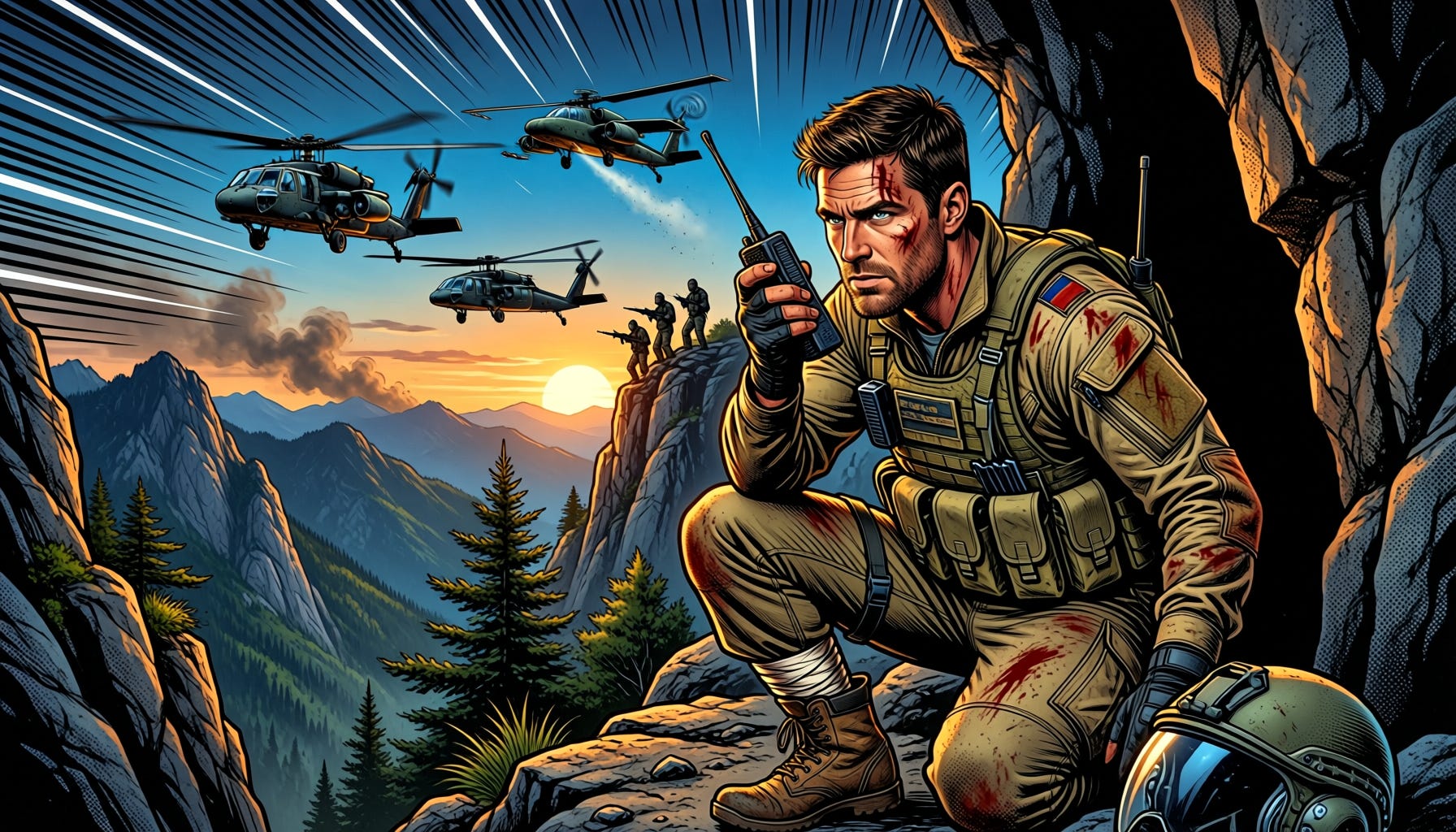
At roughly 4:40 a.m. local on Friday, 3 April 2026, an F-15E Strike Eagle from the 494th Fighter Squadron was on a deep strike inside southwestern Iran when a shoulder-fired heat-seeker found one of its engines. The aircraft — call sign Dude 44 — came apart over Chaharmahal and Bakhtiari Province. Both crew ejected and landed miles apart. In different valleys. In different wars.
The six-hour window
The pilot, Dude 44A, came down in the open. Within six hours, a U.S. Combat Search and Rescue task force crossed into Iran in broad daylight: A-10 Thunderbolts as overwatch, an HC-130J Combat King tanker, and two HH-60W Jolly Green II helicopters. One Jolly Green took ground fire on the way out. Crewmembers were hit. The helicopter flew anyway. The pilot came home.
That was the easy one.
The 48-hour hunt in the Zagros
The WSO — Dude 44B, the man the President later called “a highly respected Colonel” — landed with a sprained ankle and the wrong kind of company closing in. The Islamic Revolutionary Guard Corps put out a $60,000 bounty. Bakhtiari tribesmen, men who have hunted those mountains longer than the Air Force has existed, started walking the ridgelines with rifles.
He did what every aviator trains to do and almost none ever have to. He moved. He treated his own wound. He climbed 7,000 feet onto a limestone ridge near Kolah Ghazi National Park. He found a crevice wide enough for a man and narrow enough to hide one. He pulsed his CSEL radio in short, disciplined bursts — enough to be found, not enough to be fixed. And then he waited. In the cold. For a day and a half.
He wasn’t waiting to be saved. He was working to be saved. That’s the part the movies get wrong.
The armada
While he waited, the United States built an answer in the sky. By the President’s own count: 155 aircraft — 4 bombers, 64 fighters, 48 tankers, 13 dedicated rescue aircraft, plus enablers. Air Force Special Tactics. Navy DEVGRU. The CIA ran a deception campaign inside Iran to pull IRGC search parties the wrong way. Israeli intelligence and IDF strikes blinded Iranian hunters at the edges.
The U.S. Air Force describes this kind of operation in doctrine and almost never in practice. This night, they tested it all the way.
The last complication
They found him Saturday, 4 April, near midnight Eastern. Two MC-130J Commando IIs were waiting to exfiltrate him. The ground was too soft. Both bogged down and wouldn’t fly.
The call was made in minutes. Three replacement aircraft came in. The two stuck MC-130Js and four helicopters were destroyed on Iranian soil — rather than leave anything behind that could become a trophy.
The colonel came home with a sprained ankle and a story he may never tell in full.
Why this one matters
Every airman grows up hearing “we will never leave a warfighter behind.” Most of us say it. Fewer know what it actually buys. A downed airman in hostile territory isn’t a rescue mission — it’s a national-level decision about what this country will spend, in blood and machines, to keep a single promise to a single person.
On 3–5 April, that price was 155 aircraft, six destroyed airframes, wounded crewmen, a CIA deception campaign, and a 48-hour race against men who knew the ground better than we did. We paid it without hesitation.
If you wear the uniform today, or your kid does, or your spouse does — this is the contract. You don’t get to read the Colonel’s name. You don’t need to. You just need to know he’s home, and that the country that sent him went and got him.
If this moved you, share it with one person who thinks the military is a line item. It isn’t. It’s a promise. And promises like this one are what separate the United States from almost everyone else in the sky.
Subscribe to Voice for Valor for the stories the press release version leaves out.
Sources
- F-15E Strike Eagle, 494th Fighter Squadron, RAF Lakenheath, call sign “Dude 44,” downed 3 April 2026 — Wikipedia, “2026 United States F-15E rescue operation in Iran”; Military Times (2026-04-03); Breaking Defense; SOF News; Aircraft Insider.
- Pilot recovery in ~6 hours via HH-60W Jolly Green II, A-10, HC-130J; one HH-60W took small-arms fire — DefenseScoop; Military Times; Helis.com.
- WSO evaded ~48 hours, sprained ankle, Kolah Ghazi ridgeline, CSEL beacon discipline — TIME (2026-04-05); PBS NewsHour; Washington Post.
- 155-aircraft recovery package (4 bombers, 64 fighters, 48 tankers, 13 rescue) — Military.com; Trump Truth Social statement.
- $60,000 IRGC bounty; Bakhtiari tribesmen — Washington Post; TIME.
- CIA deception campaign, DEVGRU, Israeli support — Wikipedia; PBS; allied open-source reporting.
- Two MC-130Js destroyed on the ground plus four helicopters — NYT / Military Times reporting referenced in SOF News.
- Names of the pilot and WSO have not been publicly released. Article uses call signs only.
About the Author
Michael Komorous is the host of Voice for Valor, a podcast dedicated to sharing the stories of military veterans, first responders, and their families. A combat-rated Air Force officer, Mike served as a nuclear missile operator, C-17 pilot, and MQ-1 Predator pilot before managing rated personnel across the Air National Guard. His policy career spans legislative affairs, defense acquisitions, and geopolitical strategy at OSD Policy, including analysis of the war in Ukraine.
Today Mike builds AI systems and leads Alpha Zulu Solutions, a service-disabled veteran-owned small business focused on defense technology and government contracting. He studies advanced analytics and is a research professor at George Mason University.
Watch the podcast on YouTube | Visit voiceforvalor.com | Connect on Facebook