
I spent twenty years in the dust of Afghanistan, staring up at the jagged teeth of the Tora Bora mountains at 14,000 feet. I remember the smell of cordite mixed with the dry, metallic scent of rock. We dropped massive ordnance on those caves — the kind of firepower that would have leveled a city — yet the fighters simply slithered through tunnels we couldn’t see, vanishing into the dark. We spent two decades and two trillion dollars, and when the Taliban retook the country in 11 days, it wasn’t a defeat of armies. It was a defeat of a strategy that assumed enemies could be found, counted, and killed.
Now, look west. Look at the Strait of Hormuz.
Same War, Different Medium: The Water Is the New Mountain
It is the same story, just played out in a different medium. The water is the new mountain, and the fishing boats are the new guerrillas. As Iran’s Foreign Minister recently stated, “We studied US defeats to our east and west for two decades and incorporated lessons.” They didn’t just watch. They analyzed the failure. They saw the logic of the American military machine — linear, centralized, seeking a “center of gravity” — and realized that in an asymmetric war, the center of gravity is a ghost.
Iran has built a naval version of the Tora Bora unwinnable problem. They call it the MOSAIC DEFENSE. It is a doctrine of 31 decentralized commands, designed specifically so that no leadership decapitation is possible. If you cut off the head, the body just grows another. It is the exact inverse of the Western desire for a singular, clean victory.
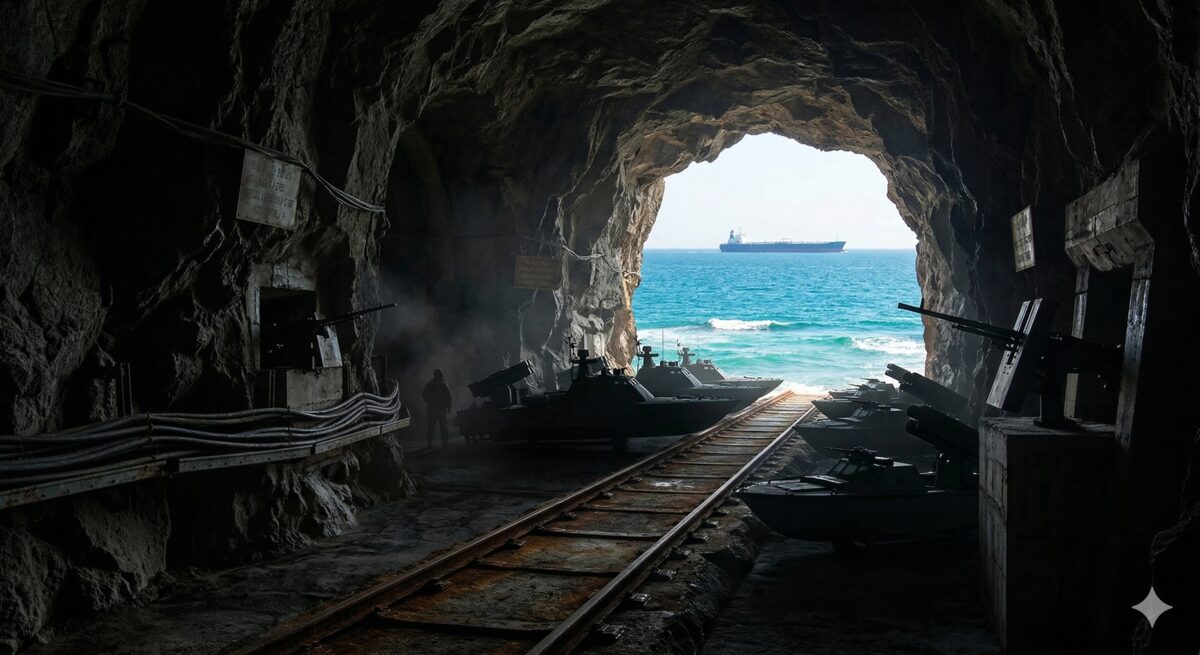
Consider the geography. The Strait is a 500-mile coastline, dotted with hundreds of ports and thousands of hiding spots. Beneath Qeshm Island lies a fortress 500 meters deep — a subterranean labyrinth that mirrors the caves of Afghanistan. Inside, they have planted over 5,000 mines and positioned mobile missiles. This is not a navy. It is a dispersed, invisible swarm.
The $50 IED vs. the $2 Billion Destroyer
The parallel is terrifying in its precision. In Afghanistan, the Taliban wore civilian clothes to blend into the population. In the Strait, Iranian “fishing boats” — often indistinguishable from legitimate trade vessels — are the ones laying mines. They are the camouflage. Just as a soldier in a village couldn’t tell a friend from a foe, a destroyer in the Strait cannot tell a merchant vessel from a mine-layer.
The economics of this asymmetry is the most brutal part of the pattern. In Afghanistan, a $50 IED would destroy a million-dollar Humvee. In the water, a $50,000 speedboat equipped with an anti-ship missile is hunting a $2 billion destroyer. A $300 million drone is being outmaneuvered by a small boat that can simply sink into the water and wait.
The enemy doesn’t need to win a battle. They just need to make the cost of the battle higher than the value of the prize.
Why “More Firepower” Is the Wrong Argument
There is no capital to capture in the Strait. There is no fleet to sink, because the “fleet” is thousands of tiny, fast, and disposable assets. There is no center of gravity to strike.
Iran understands that the American argument for victory relies on one assumption: if we apply enough force, the enemy will capitulate. But the premise that “massive ordnance equals victory” was false in the mountains, and it is false in the water. The conclusion that we can “win” this war is a fallacy of bad proof.
Iran has constructed a narrative of invincibility through invisibility. They have turned the Strait into a kill box. The strategy is to make the cost of transit so high that the world stops. By March 2026, the scenario is clear: the strait closes, global traffic drops by 70%, 21 ships are attacked, and oil hits $126 a barrel. This isn’t a prediction. It is a projection of the same logic that led to the Taliban’s return.
The Turn: We’re Not Fighting a Navy. We’re Fighting an Argument.
When we fought in Afghanistan, we tried to “build” a nation. We thought we could argue the Taliban out of existence with logic and dollars. We failed because we were fighting a fight, not an argument. A fight is zero-sum. An argument is about winning over an audience.
In the Strait, Iran is not fighting a battle. They are arguing a point: “You cannot win here.” They are altering the mood of the global audience — creating a sense of helplessness that makes the cost of intervention seem irrational. They are not seeking a formal surrender. They are seeking a shift in the mood of the global economy, a change in the desire to trade through the Strait at all.
Iran has studied our failure and built a naval version of the same unwinnable problem. They have taken the lessons of Tora Bora and applied them to the water. They have created a MOSAIC DEFENSE that ensures no center of gravity exists. They have turned the $50 IED into the $50,000 speedboat. They have made the cost of victory higher than the value of the prize.
The question is not whether we can win the battle. The question is whether we can win the argument.
What This Means for You
You don’t have to be in uniform to feel the weight of this. Every gallon of gas, every supply chain, every headline about oil prices is downstream of what happens in that 21-mile-wide chokepoint. The Strait of Hormuz is not a military abstraction — it is the economic jugular of the modern world.
More than that, this is a story about the limits of raw power when faced with a patient, adaptive enemy who has studied your defeats longer than you have. Whether you’re in a boardroom, a policy office, or a combat theater, the lesson is the same: if you keep applying the same logic to a problem designed to defeat that logic, the outcome is already written. The mountains are gone. But the ghost remains.
About the Author
Michael Komorous is the host of Voice for Valor, a podcast dedicated to sharing the stories of military veterans, first responders, and their families. A combat-rated Air Force officer, Mike served as a nuclear missile operator, C-17 pilot, and MQ-1 Predator pilot before managing rated personnel across the Air National Guard. His policy career spans legislative affairs, defense acquisitions, and geopolitical strategy at OSD Policy, including analysis of the war in Ukraine.
Today Mike builds AI systems and leads Alpha Zulu Solutions, a service-disabled veteran-owned small business focused on defense technology and government contracting. He studies advanced analytics and is a research professor at George Mason University.
Watch the podcast on YouTube | Visit voiceforvalor.com | Connect on Faceboo