
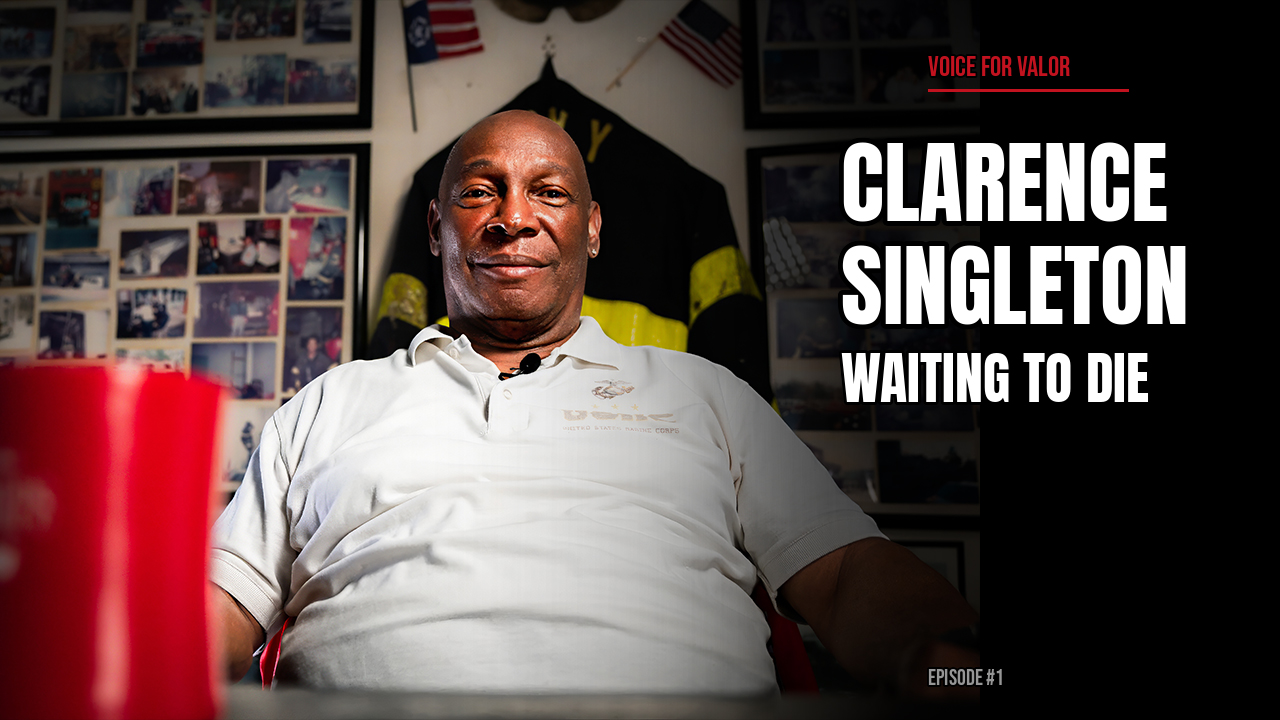
Clarence Singleton was on his hands and knees in the dust at Ground Zero, waiting to die.
The South Tower had already collapsed. Now the North Tower was coming down — that low, mechanical groan of steel giving way, then the roar. He’d run about 30 feet before his dislocated shoulder put him on the ground. And he knew the math. To be clear of a collapse zone, you need to be at least one and a half times the height of the structure away. A 110-story building. He was 30 feet out.
So he waited. He said it was peaceful.
I want to sit with that word for a moment. Peaceful. A Marine who survived Vietnam. An FDNY firefighter with over two decades of running into burning buildings. And in the moment he was certain he was about to be crushed by a skyscraper, the word he uses is peaceful.
The Training Takes Over: What Survival Actually Looks Like
When the noise stopped and Clarence realized he was still alive, he didn’t panic. He defaulted to his training.
One hand in front, probing through the dust cloud — you can’t see anything, every breath is suffocating. Keep the weight on your back leg, the way you walk through a fire when visibility is zero. Move slow. Don’t walk into anything that’ll kill you.
He came to a brick wall. Too tall to scale. He moved left. Found a shorter section, heavy brick, and managed to climb over it. On the other side, three steps down, he found the fire marshal he’d been working with.
“I see you made it,” the marshal said.
“Yeah,” Clarence replied. “You too.”
Then he did something that might sound strange. He thought of advice an old fire chief once gave him: if you’re ever in a bar fire, get close to the bar — if the ceiling falls, the bar might protect you. Standing in the ruins of the World Trade Center, Clarence’s brain served up that memory, and his first thought was: Why didn’t I get close to the bar?
That’s what training does. It doesn’t make you rational in chaos. It gives your irrational mind a structure to cling to.
The Shoulder: A Detail That Will Stay With Me
When the EMTs got him to the hospital, the doctor said they normally use anesthesia before resetting a dislocated shoulder. But they were expecting mass casualties, so they couldn’t spare it.
Clarence’s internal response — the one he didn’t say out loud — was: Who do you think you’re talking to? I’m a Marine and a firefighter. Snap it back.
They did. He washed the dust off his face in a corner sink, walked out, and went back to the collapse site.
The Wall: Where the Story Breaks
Here’s where the story breaks.
Sometime after 9/11, Clarence joined a support group. He told the story of the brick wall — the one that was too tall to scale, the shorter section he climbed over, the steps on the other side. The wall that channeled his escape route and kept him alive.
A woman in the group said: “Clarence, I worked down there for 15 years. There is no wall like the one you described.”
He’s gone back to look. His son has gone with him. They’ve searched the area multiple times.
The wall doesn’t exist. It never did.
What the Therapists Think: When the Mind Builds What It Needs
Clarence was wounded on December 23rd in Vietnam. For two decades, he couldn’t celebrate Christmas. He didn’t know why until a therapist pointed out the connection — a trauma he’d carried so deep it had rewritten his relationship with an entire season.
The same therapists believe the wall at Ground Zero was something similar. Not a hallucination, not a lie — a construction. His mind, trained by decades of firefighting and combat, built a structure in the chaos because that’s what it needed to survive. The wall was real to Clarence because it had to be.
I’m not a therapist. I don’t know if that’s right. But I know this: the wall saved his life, whether it was made of brick or something else. And the fact that he can tell that story — honestly, including the part where the wall isn’t there anymore — tells you everything about the kind of man Clarence Singleton is.
The Christmas He Got Back
The moment in our conversation that hit me hardest wasn’t 9/11. It was Christmas.
Clarence carried that wound for 20 years without understanding it. Every “Merry Christmas” landed like a punch he couldn’t explain. He’d grumble internally. He didn’t celebrate. He didn’t know why.
One conversation with a therapist — “Clarence, you were wounded December 23rd. You lost buddies. No wonder you feel that way” — and something unlocked. He started celebrating again. He wears a little red Santa hat now.
Twenty years of suffering. One sentence that connected the wound to the pain. One moment of someone saying: I see why you hurt.
That’s what talking does. That’s the whole reason Voice for Valor exists.
What Clarence Taught Me
Clarence is 77 years old. He looks 60. He exercises four days a week, eats mostly clean, and stays what he calls “spiritually, mentally, and physically fit.” He suffered — Vietnam, 9/11, PTSD, depression — and he’s still here, still sharing, still showing up.
He told me: “Everything that has happened to me is happening for a reason. That’s one of the reasons I’m talking to you — to pass this on to other people in the same situation. Say, hey, look at Clarence. He made it. Maybe I can too.”
Not everyone has a wall that saves them. But everyone has a story that could save someone else, if they’re willing to tell it.
Watch the Full Episode
Clarence Singleton joins Voice for Valor for the full conversation — Vietnam, 9/11, PTSD, and the wall that doesn’t exist. Subscribe on YouTube for new episodes every week.
About the Author
Michael Komorous is the host of Voice for Valor, a podcast dedicated to sharing the stories of military veterans, first responders, and their families. A retired Air Force officer, Mike served as a nuclear missile operator, C-17 pilot, and MQ-1 Predator pilot before managing rated personnel across the Air National Guard. His policy career spans legislative affairs, defense acquisitions, and geopolitical strategy at OSD Policy.
Today Mike builds AI systems and leads Alpha Zulu Solutions, a service-disabled veteran-owned small business focused on defense technology and government contracting.
Subscribe to the newsletter | Watch on YouTube | Visit voiceforvalor.com