
Before Officer Training School, Staff Sergeant Rose laid it out like the math was already settled.
There was exactly one pilot slot in the class, he said. My test scores were not good enough to win it. I had zero flight hours, and I would be competing against candidates with hundreds or thousands.
Pilot was off the table.
I believed him.
That is the part that still matters. Not just that he said it. Not just that the information was incomplete. The part that matters is that I let someone else’s version of the map become the boundary of my own ambition.
I did not know the system yet. I did not know what questions to ask. I did not know which doors had timing windows, which tracks had selection steps, or which opportunities had to be claimed before OTS. I was trying to get into the Air Force. He was the recruiter. So when he said the door was closed, I treated that like a fact.
Thirteen weeks later, I knew better.
I graduated from OTS as a Distinguished Graduate. I finished ahead of half the pilot-track candidates in my class. I earned top physical fitness and top public speaker. And the class that supposedly had one pilot slot had more than twenty.
After graduation, I went back to the recruiting office.
I stood in the doorway with the afternoon light behind me and told him the truth I had carried through thirteen weeks of push-ups, inspections, formations, and long hours standing at attention.
There were over twenty pilot slots in my class. I graduated ahead of half of them. You told me my scores were not good enough. I graduated ahead of half the people whose scores were.
That was not a victory lap. It was a reckoning.
Every opportunity I had been steered away from suddenly looked different. Combat controller tryouts I could not pursue because I had not been told the selection process had to happen before OTS. A navigator track pushed as the practical option. A pilot path dismissed as unrealistic because the math had been presented in a way that made me smaller.
The mistake was not that I listened to a recruiter. You should listen to people who know the system. The mistake was that I stopped there.
I accepted a verdict before I had the full picture.
The Lie Inside “Good Enough”
“Good enough” sounds like a standard. Sometimes it is. Standards matter. Scores matter. Fitness matters. Timing matters. Requirements matter.
But sometimes “not good enough” is not a standard at all. Sometimes it is a shortcut. Sometimes it is how a gatekeeper keeps you in the lane that works best for them. Sometimes it is a partial truth delivered with enough confidence that you forget to ask for the rest of the map.
Veterans know this feeling. Founders know it too. So do spouses, first responders, young leaders, and anyone who has ever tried to build a life after being told the path was too narrow.
There is only one slot.
You do not have the background.
You are too late.
You are too old.
You do not have the right network.
You are not ready.
Maybe some of that is true in the moment. Maybe you do need more hours, a better score, another certification, a different timeline, or a smarter path. But needing a next move is not the same thing as being disqualified.
That distinction can change a life.
The Practical Lesson
If someone tells you there is only one slot, your next question is not, “Am I good enough?”
Your next question is, “Show me the whole system.”
What are the actual requirements? Who decides? When does selection happen? Are there waivers? Are there alternate tracks? What closes before the official start date? Who has done this before? What are the direct routes, and what are the back doors? What tradeoffs come with each one?
Do not confuse encouragement with a plan. Encouragement feels good, but it will not get you through a selection board. Do not confuse discouragement with truth either. Discouragement can sound official and still be incomplete.
The move is to verify the map.
Write down the “one slot” story you have accepted. Then test it. Find the regulation, the deadline, the selection criteria, the person who actually owns the decision, and the example of someone who made it through another way.
You may discover the door really is closed for now. Fine. Then you know what to build next.
But you may discover what I discovered: the door was never as narrow as you were told.
Why This Still Matters
I did not become a pilot because someone gave me permission to believe in myself. I moved forward because the truth turned out to be bigger than the story I had been handed.
That is the lesson I want the reader to carry.
No one gets final authority over whether you are good enough. They may have authority over a form, a process, a score, a board, or a deadline. They may have information you need. They may even be right about the obstacle in front of you.
But they do not own the verdict on your future.
So ask better questions. Get the full map. Find the twenty slots. Then do the work required to stand in the room and tell the truth.
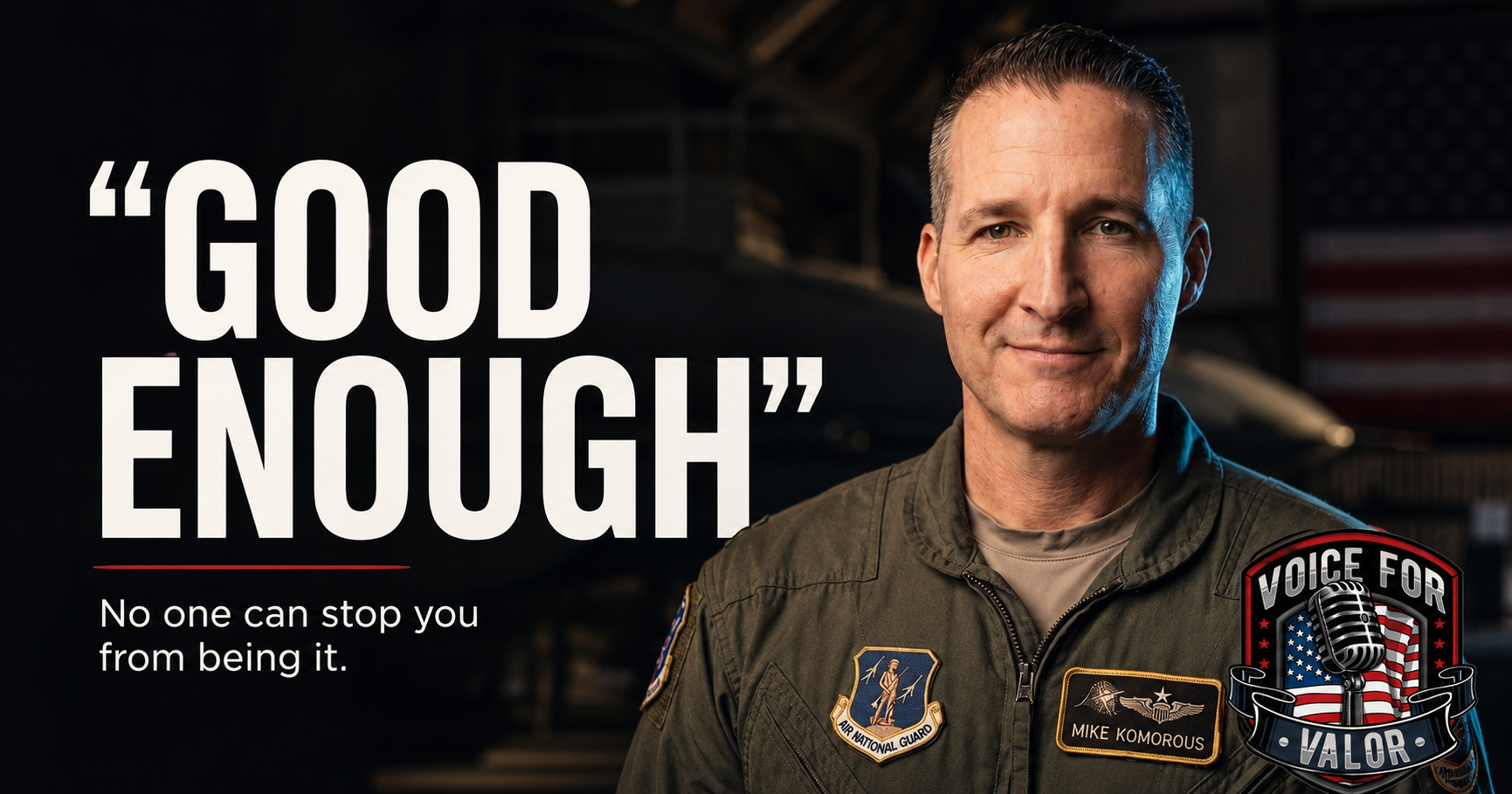
No one can stop you from being good enough.
But you can stop yourself if you believe the first person who tells you that you are not.
Voice for Valor
Voice for Valor exists for stories like this: the ones where the lesson was paid for before it was understood. If this story helped you, stay with the work. There is more coming from the cockpit, the Pentagon, the family table, and the long road home.