
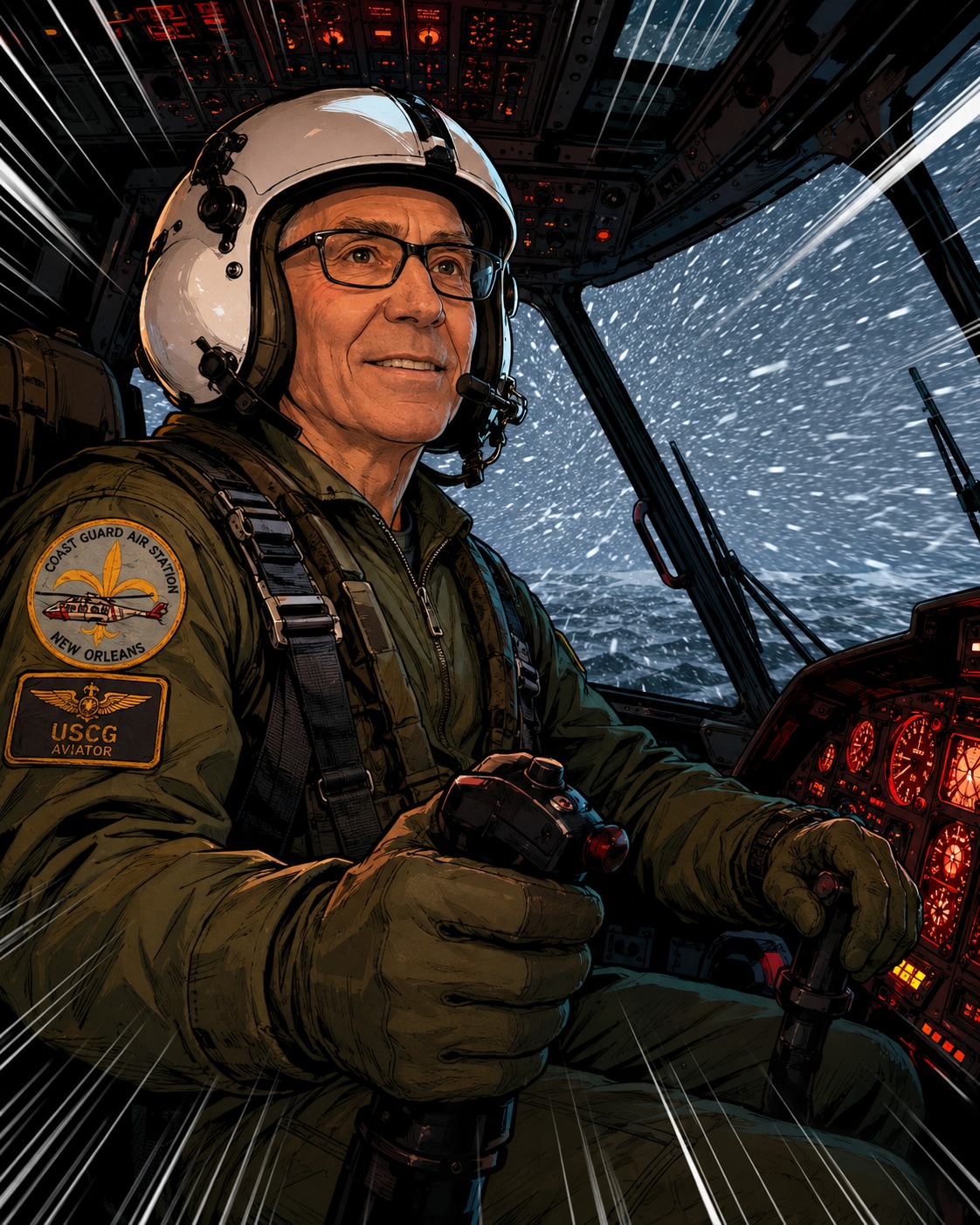
December 10, 1987. Seven o’clock at night near Sitka, Alaska. A 26-foot commercial fishing boat is sinking somewhere out in the black water, the skipper calling Mayday on a radio that John Whiddon’s crew can hear but not yet see. There is no GPS in 1987. There are no night-vision goggles. There is a TACAN, a radar set that just iced over at 500 feet, and a co-pilot who is about to be asked to talk the skipper into counting backwards from ten so the helicopter can take a needle-bearing on his voice.
Whiddon is the aircraft commander. The man in the water — when there is finally a man in the water — will be Jeff, his rescue swimmer. Neither of them knows yet that what they are about to do has never been done before in Coast Guard history.
A Whiteout Out of Nowhere
The launch was routine until it wasn’t. Whiddon climbed his H-3 to 500 feet, set course toward the position, and almost immediately the radar quit. He looked out the window. The aircraft was completely iced over. He dropped to 300 feet to shed it. The radar came back. He climbed again.
The blizzard hadn’t existed when they left the base. It had risen up around them in minutes. They could hear the fisherman calling Mayday. They could not see him.
So Whiddon asked his co-pilot — a man who would later fly for Alaska Airlines — to put the skipper on the radio and have him count down from ten backwards. The helicopter’s ADF needle swung toward the voice. They followed the needle until a 26-foot boat appeared underneath them in the snow, pitching in seas that were now running 35 feet and rising. The wind was gusting past 70 knots.
A 26-foot boat is the size of a small pleasure craft. There was no deck to land a rescue basket on. There was no margin for anything.
Going Backwards and Down
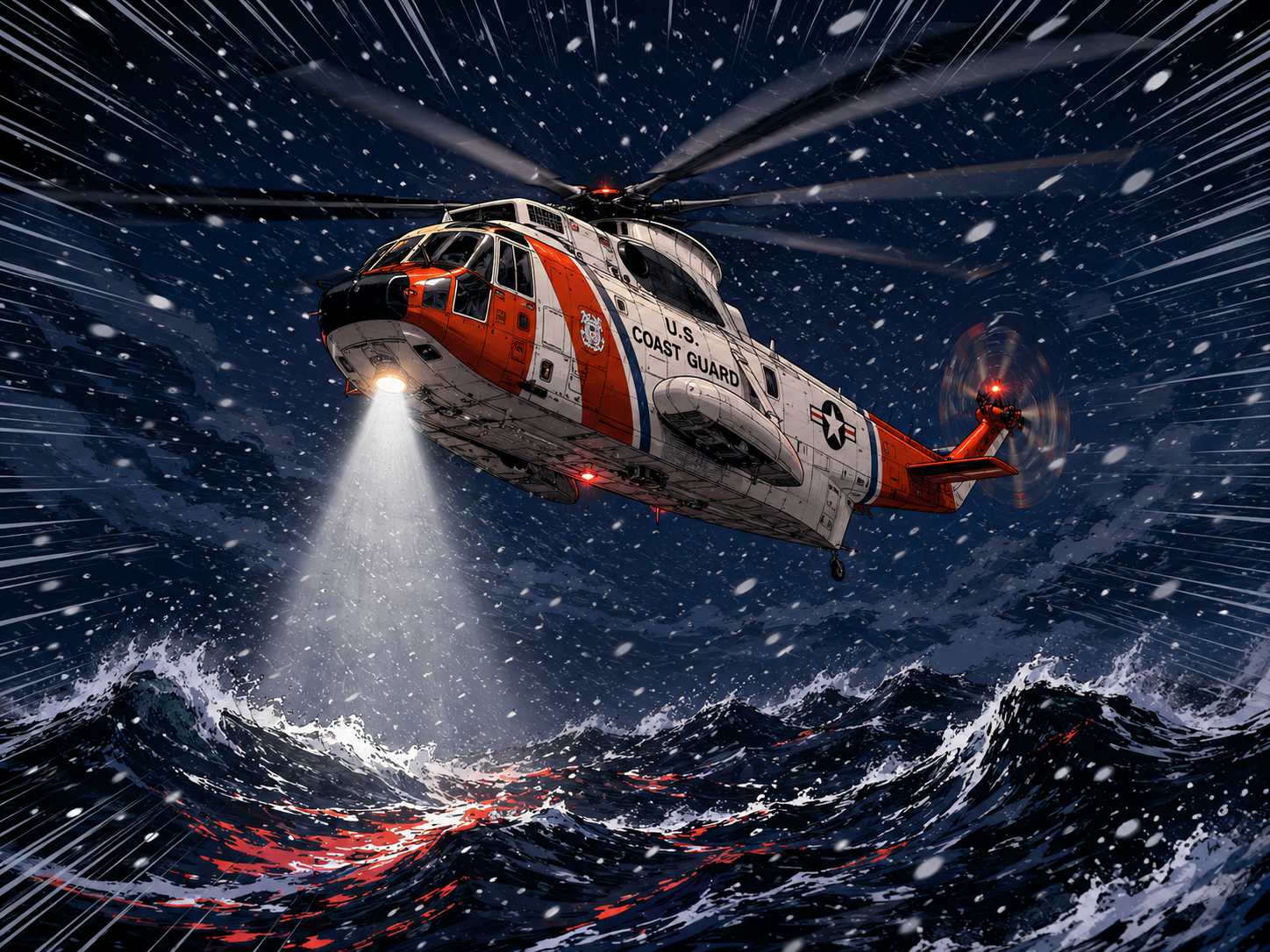
A 50-foot hover at night, over moving water, with no fixed visual reference, in a 70-knot wind, is not a maneuver. It’s a fight. Whiddon held it. And then the nose of the H-3 pitched up fifteen degrees, all on its own, and the aircraft began moving backwards and down.
“My co-pilot looked at me and I looked at him but we didn’t say anything. We both knew that, hey, this is it. We’re going in. We’re going to die. I mean there’s just no — there was no panic. It was just like, hey, we’re going in.”
The torque cages were redlining. The engines were redlining. Whiddon had full forward cyclic and the helicopter was not responding. Fifty knots backwards. Down toward the water.
And then he felt someone lean over his shoulder.
In the H-3, unlike newer airframes, the crew compartment opens into the cockpit. A flight mechanic can walk up behind the pilots. Whiddon felt the presence so distinctly that he turned and told his hoist operator to sit down — they were going to crash, this was not the time to be standing in the cockpit. The hoist operator answered from the back of the aircraft. I’m not up here, sir.
At that moment the helicopter shuddered to a stop. Fifteen feet above the water. Fifteen degrees nose up — meaning the tail rotor was within a foot or two of the sea. Airspeed indicator at a 15-foot hover: 55 knots.
It would happen three more times before the night was over.
35:54 — The launch and the first iced-over approach into Sitka
The First Deployment
The basket was useless. There was no boat deck left to put it on. The seas were throwing the hoist line all over the sky. So Whiddon told the skipper, over the radio, to put on his survival suit and jump.
The skipper jumped. As he hit the water, the boat went stern-down and then bow-up, and then it wasn’t there anymore. Only then did Whiddon learn what the skipper had been holding in his arms: a six-year-old boy, his son, strapped to his father’s chest before they went over the side together.
The basket still wouldn’t reach them. The wind kept driving it away from the survivors in the water.
The Coast Guard rescue swimmer program was, in December 1987, brand new. It had never been used at night, at sea, in real conditions. Not once. Whiddon turned in his seat and looked at Jeff.
Jeff, we can’t rescue these guys unless you’re willing to go.
Put me in, sir.
41:12 — The moment Whiddon decides to deploy a rescue swimmer for the first time in Coast Guard history
”We Do This All the Time”
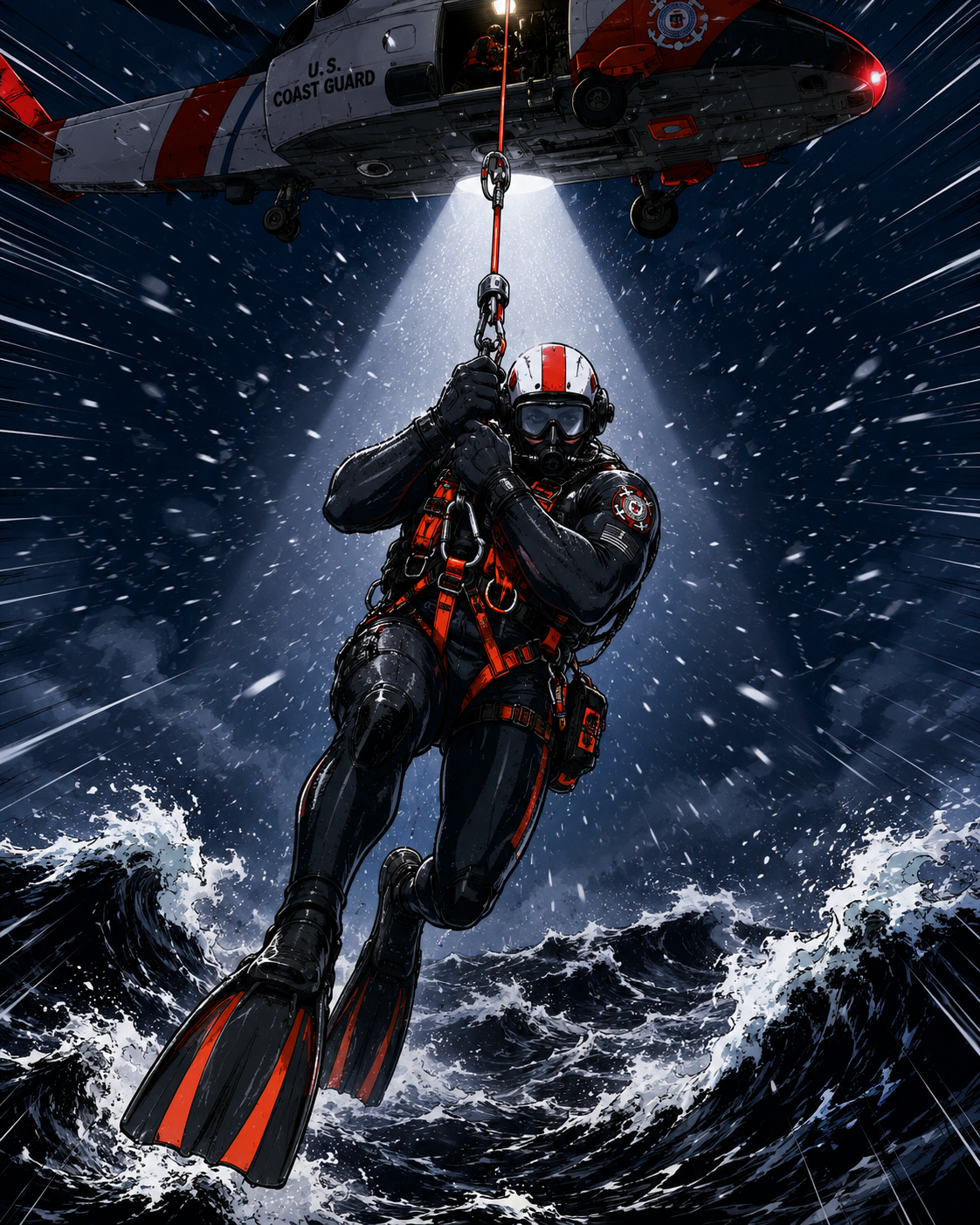
They strapped Jeff in. They put him out the door on the sling. The instant his fins hit the water, the helicopter took another backwards-and-down shove from the storm, and Jeff had to punch off the cable to avoid being dragged.
Before he’d dropped Jeff, Whiddon had said something to the rest of his crew that he meant exactly the way he said it: I don’t care what happens to the fisherman. We are not losing our rescue swimmer. He had not known yet about the boy.
Jeff was now alone, spinning in 35-foot seas in a blizzard, with no visual reference for which way to swim. Whiddon broke his own rule — he had told the crew to keep their eyes locked on the survivors — and slewed the helicopter’s searchlight off the fisherman and over to Jeff. He saw the reflective tape on Jeff’s suit. He held the beam steady. Somehow, in the dark and the wind, Jeff understood, and he followed the beam through four mountains of water until he was on top of the father and the son.
Who are you? the fisherman asked.
I’m a rescue swimmer. I’m here to get you out.
Do you think they can rescue us?
No problem. We do this all the time.
It was Jeff’s first time, ever, in real conditions.
41:50 — Jeff hits the water and the helicopter is shoved backwards again
The Way Home
They got knocked off the survivors again. And again. Forty-five minutes into a hover that should have lasted ten, Whiddon polled the crew. There was no other helicopter coming. The only spare bird at the station was broken. He asked, out loud: should we drop the life raft and let them ride out the night?
Nobody answered. Which Whiddon took, correctly, as the answer.
They went back in. They got the basket to the fisherman and the boy. They got it to Jeff. And as Jeff stepped into the basket, the wind hit them again, and the helicopter started dragging the swimmer through the seas at 50 knots while he was still on the cable. He hit the crests three times. The aircraft shuddered on the third one. From the back of the helicopter Whiddon heard his flight mechanic over the intercom: You killed him. You killed him. You killed him.
Then the cable came up. Jeff came swinging in close enough to the tail rotor that the crew in the back wrestled the hoist line to keep it from being chopped. He had lost his mask and his snorkel. He came inside the cabin, threw up twice, gave a thumbs up, and was fine.
They flew back to the base. They had done something nobody had done before. Whiddon, when he tells the story, mentions almost in passing that he did about half a million dollars worth of damage to the helicopter that night.
44:14 — The second hoist attempt and the swimmer dragged through the seas
The Coast Guard would put rescue swimmers into the water at night, at sea, thousands of times after December 10, 1987. The program would save hundreds of lives. But the first time a rescue swimmer ever went down on a hoist into a black ocean in a blizzard, it was Jeff, and it was John Whiddon at the controls, and it was a father and a six-year-old boy in the water below them, and the helicopter went backwards and down four times before they came home.
Honor, Preserve, and Teach the Legacy — the Distinguished Flying Cross Society
Stories like this one — aircrews holding a 50-foot hover in a 70-knot blizzard so somebody else’s child gets to grow up — are the reason the Distinguished Flying Cross Society exists. The DFC is awarded for heroism or extraordinary achievement in aerial flight, and the Society — a 501(c)(3) — exists to honor, preserve, and teach the legacy of the men and women who have earned it. Their work funds scholarships for DFC recipients’ descendants, supports members through local chapters and the annual reunion, and pushes these stories forward so the next generation knows what was done and why. If John Whiddon’s night over Sitka moved you, visit dfcsociety.org and consider joining, donating, or just sharing one of their stories.
Sources & Fact-Check Trail
This article is drawn from the Voice for Valor conversation with John Whiddon — watch the full episode. All quoted and paraphrased detail (date, location, aircraft type, sea state, wind speed, crew composition, the “presence” moment, Jeff’s exchange with the fisherman, the damage figure) is taken from Whiddon’s first-person account in chapters 7-8 of the episode transcript. Narrative craft informed by the Voice for Valor writing-experts knowledge base.
About the Author
Michael Komorous is the host of Voice for Valor, a podcast dedicated to sharing the stories of military veterans, first responders, and their families. A combat-rated Air Force officer, Mike served as a nuclear missile operator, C-17 pilot, and MQ-1 Predator pilot before managing rated personnel across the Air National Guard. His policy career spans legislative affairs, defense acquisitions, and geopolitical strategy at OSD Policy.
Today Mike builds AI systems and leads Alpha Zulu Solutions, a service-disabled veteran-owned small business focused on defense technology and government contracting. He holds advanced credentials from MIT, Wharton, and the Eisenhower School at National Defense University.
Watch the podcast on YouTube | Visit voiceforvalor.com | Connect on Facebook